
In this guide (9 sections)
- Our top picks
- Gun safe hygrometer – quick answer and top picks
- How we picked these hygrometers
- Gun safe hygrometer reviews
- What humidity should a gun safe be – and who says so
- Why two hygrometers disagree, and the salt test
- Where to put the hygrometer in a gun safe
- What to do when the reading is off
- Questions safe buyers ask
We earn a commission if you buy through links on this page, at no extra cost to you. It never changes what we recommend. How we make money.
How we picked these
- Review themes from 70 verified-buyer and owner reviews on retailer sites, so every pick shows what buyers praise and complain about.
- 40 owner posts, user discussions and expert reviews read across 9 sources.
- Every spec checked against 14 maker and retailer pages.
- We did not test these products ourselves, and we say so. All sources are linked at the end of this guide.
Our top picks
 Best overall · 3.8/5Hornady Wireless Hygrometer
 Best single-unit digital · 3.6/5Hornady Digital Hygrometer
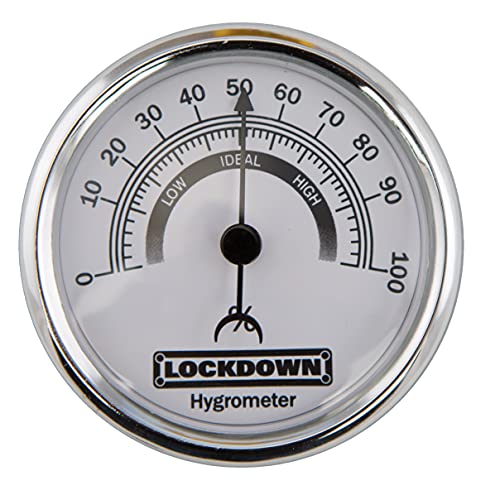 Best no-battery dial · 3.1/5Lockdown Vault Hygrometer
 Best budget digital · 3.6/5TempPro TP49 Digital Hygrometer
The short answer
- The Hornady Wireless Hygrometer is our top pick because its remote sensor sits inside the safe and the display outside, so you read the humidity without opening the door.
- Hold 40-50% relative humidity and act above 55%. NRA museum curators keep guns at 50-55%, the Library of Congress says 30-55% for paper, and metal corrosion speeds up a lot above 75%.
- Consumer hygrometers drift and often disagree by a few points. A 12-hour salt test (75% RH) tells you which reading to trust.
- On a budget, the TempPro TP49 states ±2% RH from 30-80%; the Lockdown Vault Hygrometer dial needs no batteries but should be checked with salt.
You open the safe after a muggy week, and the little gauge on the door says 62 percent. Is that bad? Is the gauge even right? A gun safe hygrometer exists to answer exactly that, and the short answer is: hold 40 to 50 percent, act above 55, and check your gauge with salt once a year. Our top pick is the Hornady Wireless Hygrometer, because its remote sensor lets you read the inside of the safe without opening the door and letting damp air in.
Gun safe hygrometer – quick answer and top picks
A gun safe hygrometer is a small humidity gauge that lives inside the safe and shows the relative humidity (RH) around your guns, so you know whether your dehumidifier or desiccant is actually working. Four models made our list.

Here is how the picks split up by job:
- Best overall: the Hornady Wireless Hygrometer, with a remote sensor inside and the display outside.
- Best single-unit digital: the Hornady Digital Hygrometer, a touchscreen gauge with high/low memory.
- Best no-battery dial: the Lockdown Vault Hygrometer, a 2 3/4 inch mechanical dial.
- Best budget digital: the TempPro TP49, the only pick that states its accuracy.
This table compares the four on what matters for a safe:
| Pick | Type | Read without opening | High/low memory | Stated RH tolerance | Power |
|---|---|---|---|---|---|
| Hornady Wireless | Digital, remote sensor | Yes | Yes | Not published | 4 AAA |
| Hornady Digital | Digital | No | Yes | Not published | 2 AAA |
| Lockdown Vault | Mechanical dial | No | No | Not published | None |
| TempPro TP49 | Digital | No | No | ±2% at 30-80% RH | 1 AAA |
A hygrometer measures. It does not dry anything, and it has nothing to do with fire or burglary protection.
How we picked these hygrometers
We only kept a hygrometer if at least two of the pages ranking for this search recommend it, and then we read the maker’s manual and what owners report. The list came from the gun safe retailer GunSafesNow, two hygrometer roundups, and forum threads on SIG Talk, BobIsTheOilGuy and Sniper’s Hide.

Models named by only one page, such as the SwitchBot Meter Plus and a few AcuRite and Govee gauges, were left out. We have not used these hygrometers ourselves. Everything below comes from maker manuals, spec pages and the owner posts and retailer reviews we read, and each pick is scored with the rubric on our how we score page. Fire is left out of the scores because none of these is meant to resist fire.
From our notes: When we lined up the manuals side by side, the surprise was what was missing. Hornady’s instruction sheets for both its hygrometers list the humidity range, the update interval and the batteries, but no accuracy figure at all. TempPro states ±2% RH for the TP49 between 30 and 80 percent. Then we noticed the comfort icon in the Hornady wireless manual: it calls anything from 30 to 60 percent comfortable. That is fine for a living room, but 60 is above where we would want a safe full of blued steel to sit, so read the number, not the smiley face.
Gun safe hygrometer reviews
Each review covers what the maker states, what owners report, and which safe and owner it suits. The video below, from Hornady’s own channel, shows how the wireless base and remote sensor work together.


Hornady Wireless Hygrometer: Best overall
3.8Best Safe Spec Score out of 5
- Security (lock and build)7/10
- Access (speed and ease)9/10
- Capacity8/10
- Value7/10
No fire claim, so fire is left out. Security reflects build and reliability (one-year warranty, no published RH tolerance); access is high because you read it without opening the safe; two sensors with high/low memory lift capacity; value is fair for a two-piece unit.
What we like
- Reads the safe interior from outside, so the door stays shut
- High/low memory, all-time or reset every 24 hours, on base and remote
- Magnets, quick-connect bracket, screws or Square-Lok mount
What we don't like
- Hornady's manual gives no humidity tolerance, so accuracy is not stated
- Owners report weak magnets, a stand that folds easily and, for one user, a remote that dropped its link
What owners and reviewers say from 7 reviews and posts we read
Praised for
- Pairs on its own when the batteries go in
- Lets owners see conditions inside the safe without opening it
- Base and remote side by side read within a point or two
Common complaints
- Magnets feel weak and the fold-out stand collapses if bumped
- One user's remote kept disconnecting through a few inches of wood even at close range
Read on: r/homeautomation: Gun Safe Hygrometer? · Tractor Supply: Hornady Wireless Touchscreen Gun Safe Hygrometer
Who it's for: For a long-gun or full-size safe in a garage, basement or closet where you want to see the humidity daily without letting room air in; the steel box shortens the wireless range, so test the link before mounting.
Two pieces make this one different: a remote sensor that sits on a shelf inside the safe and a touchscreen base that sits outside on the door or a nearby shelf. Per the manual, both show current, high and low humidity and temperature, the memory can run all-time or reset every 24 hours, the humidity range is 10 to 99 percent RH, and readings update every 50 seconds. Each unit takes two AAA batteries, not included, and the kit includes magnets, a quick-connect bracket and screws.
Hornady rates the read distance at 100 feet unobstructed, and a steel safe is about as obstructed as it gets. Owners in retailer reviews say it paired by itself and that the base and remote read within a point or two side by side. One says the remote transmits out of his gun safe without trouble. The complaints are physical: weak magnets, a stand that folds if you bump it, and one cigar-humidor user whose remote kept dropping its link at close range. We would pair it, close the door, and watch the display update before drilling or sticking anything.
Hornady Digital Hygrometer: Best single-unit digital
3.6Best Safe Spec Score out of 5
- Security (lock and build)7/10
- Access (speed and ease)7/10
- Capacity7/10
- Value8/10
No fire claim, so fire is left out. Solid build with a one-year warranty but no stated RH tolerance; access drops because you open the door to read it; high/low memory and two mounts earn fair capacity and good value.
What we like
- Touchscreen shows current plus high/low humidity and temperature
- Updates every 10 seconds, per the manual
- Door bracket or fold-out stand, so it needs no shelf space
What we don't like
- Must open the safe to read it
- No humidity tolerance in the manual; one owner found it slightly off his other meters and another's sensor failed in a day
What owners and reviewers say from 11 reviews and posts we read
Praised for
- Two units in identical safes read within 1% RH of each other
- Easy-to-read touchscreen and the 24-hour high/low record
- Batteries last many months
Common complaints
- One owner found it a little less accurate than his other meters
- One buyer says the humidity sensor failed within a day
Read on: r/Firearms: Hydrometer for a gun safe · Tractor Supply: Hornady Digital Safe Hygrometer reviews · r/ar15: Are there hygrometers that actually work?
Who it's for: For any gun safe owner who opens the safe often anyway and wants a readable digital gauge with high/low memory; you have to open the door to read it, which lets room air in.
If you open the safe every day anyway, the Hornady Digital Hygrometer gives you the same touchscreen and high/low memory in one piece. Its instruction sheet lists a 10 to 99 percent RH range, a 10-second update and two AAA batteries, not included. It clips to the inside of the door with a quick-connect bracket or stands on a shelf.
A Reddit owner in r/Firearms said he was very happy with his and liked the daily high and low. One retailer reviewer bought two for identical safes and found them 1 percent apart on humidity after a day, and another says his reads close to his other meters but not quite as accurate. On the downside, one buyer reports the humidity sensor failed within a day, and a poster in r/ar15 says a Hornady hygrometer died after about six weeks (he doesn’t say which model). Like the wireless version, the manual states no accuracy figure.
Lockdown Vault Hygrometer: Best no-battery dial
3.1Best Safe Spec Score out of 5
- Security (lock and build)6/10
- Access (speed and ease)6/10
- Capacity5/10
- Value8/10
No fire claim, so fire is left out. Simple and battery-free, but dial accuracy drifts (security 6); you open the safe to read it and there is no memory (access 6, capacity 5); low cost keeps value high.
What we like
- No batteries, per the listing, so it never goes blank
- Large numbers are easy to read at a glance
- Small 2 3/4 inch dial mounts with a fastener or hook-and-loop pad
What we don't like
- Dial gauges drift; one owner's unit read 5 points higher than a digital gauge beside it
- No temperature, no high/low memory and no remote reading
What owners and reviewers say from 2 reviews and posts we read
Praised for
- Easy to read and quick to settle
- One reviewer found it close to his electronic hygrometer
Common complaints
- An owner running it beside a digital gauge saw 50% on the dial and 45% on the digital and could not tell which was right
Read on: BobIsTheOilGuy: Safe hygrometers · Lockdown: Hygrometer 222111 (ExpertVoice review)
Who it's for: For a small safe or a second gauge on a shelf where you never want to change batteries; dials drift, so check it with a salt test and treat the reading as a rough guide.
No batteries, no screen, nothing to fail at 2 a.m. The Lockdown Vault Hygrometer is a 2 3/4 inch round dial, per Lockdown, that mounts with an included fastener or a hook-and-loop pad and shows humidity in large numbers. It reads humidity only: no temperature, no memory.
An analog dial hygrometer like this is where most accuracy complaints start. A BobIsTheOilGuy member running this dial beside a ThermoPro digital saw 50 percent on the Lockdown and 45 on the digital and asked which to believe. Another member’s answer: “They aren’t precision instruments.” A reviewer on Lockdown’s site found his close to his electronic unit. We would use it as a cheap second gauge on a top shelf, salt-test it first, and write the offset on a strip of tape.
TempPro TP49 Digital Hygrometer: Best budget digital
3.6Best Safe Spec Score out of 5
- Security (lock and build)7/10
- Access (speed and ease)7/10
- Capacity6/10
- Value9/10
No fire claim, so fire is left out. A published ±2% RH tolerance earns fair security; it must be read with the door open and has no memory (access 7, capacity 6); low cost per unit makes value very high.
What we like
- ±2% RH from 30-80%, the only stated tolerance among our picks
- Magnetic back, stand or hanging hole; one AAA battery
- Small enough to put one on each shelf
What we don't like
- No backlight and no high/low memory, per the maker
- One owner wishes the two readouts used different digit sizes so humidity and temperature are easier to tell apart
What owners and reviewers say review themes from 70 owner reviews, plus 20 posts and reviews we read
Praised for
- Readings match owners' other sensors closely
- Small, with a magnet that holds on steel
- Several owners run one in each safe or room
Common complaints
- One owner wants the humidity and temperature digits in different sizes
- No backlight, so it is hard to read in a dark safe
Read on: SIG Talk: Inexpensive hygrometer (check humidity level in your safe) · Walmart customer reviews: TempPro TP49BW (70 reviews)
Who it's for: For owners who want a cheap, stated-accuracy gauge in each safe or one per shelf; it has no backlight, no high/low memory and no remote, so you open the door to read it.
Sold for years as the ThermoPro TP49 and now under the TempPro name, the TempPro TP49 Digital Hygrometer is a palm-size gauge and is the only pick here with a published accuracy: the maker states ±2% RH from 30 to 80 percent, ±3 outside that, with a 10-second refresh. It runs on one AAA battery and has a magnetic back, a stand and a hanging hole. There is no backlight and no high/low memory.
On SIG Talk, the thread starter bought several for his gun safes and calls them a big step up from color-dot humidity strips, and another member likes the magnets for mounting. Walmart reviewers mostly describe it as accurate and easy to read from across a room. The one recurring gripe is small stuff, like a reviewer who wants the humidity and temperature digits in different sizes. Small enough to put one on each shelf of a big safe.
What humidity should a gun safe be – and who says so
Hold 40 to 50 percent relative humidity in a gun safe and act when the reading stays above 55; that range sits inside every sourced number we found. It is also the question owners keep asking. “Good info, what % do you keep at?” was the reply that ended one SIG Talk thread.

Here is what the sources actually say:
- Firearms: curators at the NRA National Firearms Museum keep their collection at 70 degrees with 50 to 55 percent relative humidity, because too little moisture cracks wood stocks and grips.
- Paper: the Library of Congress calls a 30-55% relative humidity environment safe for most books, at 70 degrees or below.
- Metal: the Canadian Conservation Institute says that for metals, lower is better and above 75% RH all corrosion speeds up a lot.
- Safe guidance: Howard Environmental, a mold remediation firm, recommends 30 to 50 percent inside safes.
So drier is not always better. As one Sniper’s Hide member put it, “a lot of people think you need it super dry in a safe, which isn’t true at all.” A safe of all-synthetic rifles can run near 40. A safe with walnut stocks and passports should sit nearer 45 to 50, not at 20. If you keep documents in a fire-rated safe, our fire rated gun safe guide explains why those safes hold moisture.
Why two hygrometers disagree, and the salt test
Two consumer hygrometers a few points apart is normal; a salt test tells you which one to trust. The BobIsTheOilGuy thread above ended with one reply that sums it up: “Obviously both COULD be way off in the case of consumer grade hygrometers it seems.” Dials drift more than digital sensors, which is why a Reddit owner in r/guns told a new safe buyer to stay away from cheap dial gauges.
Run a salt test in 12 hours
The salt test works because a damp pile of table salt in a sealed space holds the air at about 75 percent RH. Follow these steps, adapted from TempPro’s instructions:
- Put about two teaspoons of table salt in a bottle cap or small dish.
- Add a few drops of distilled water so the salt is damp but not dissolved.
- Seal the dish and the hygrometer in a zip bag.
- After 12 hours, read the gauge. A correct one shows 75 percent.
- If it reads 71, add 4 to every reading from now on. Write the offset on tape on the back, or turn the adjustment screw if your dial has one.
The BobIsTheOilGuy owner ran this on his ThermoPro and got 74 against 75. Redo it once or twice a year, as Howard Environmental suggests.
Where to put the hygrometer in a gun safe
Place the hygrometer or its sensor at mid-height, away from the door seam, the walls and any heated dehumidifier rod, where air moves freely. Right above a rod it reads the warm spot. Against a cold outside wall it reads the damp spot, where the steel can drop below the dew point, the temperature at which moisture in the air condenses on metal.
Reading without opening is the other half of the problem. Every time the door opens on a humid day, room air rushes in and the number jumps. A wireless remote sensor solves that, with caveats owners have learned the hard way. A Sniper’s Hide member said the Golden Rod wireless sensors he used “only seem to hold up for about 6mo to a year then they stop working,” and a Dean Safe reviewer found his Lockdown wireless pair only connected when the display sat within about 2 feet. A steel box blocks radio. So set the display as close to the safe as you can, put the remote near the door rather than deep in the back, and change the batteries in both units at the same time, which Hornady’s manual recommends to keep them paired.
What to do when the reading is off
Treat a steady reading above 55 percent as a problem to fix this week, and a reading under 30 as a reason to back off the drying. The hygrometer is what turns a vague worry into a number you can act on.
Work through it in this order:
- Above 55% for days: recharge or replace a saturated silica gel desiccant, confirm the gun safe dehumidifier rod is warm, and pull out damp foam cases and gun socks. In an AR15.com humidity thread, one reply was blunt: “Ditch the gel and dri packs, they just hold moisture.” That is true of packs nobody recharges, and the hygrometer is how you know they are full.
- High only after opening: normal. Watch the high/low memory; if it falls back within a day, you are fine.
- Under 30%: common in dry climates. Remove some desiccant before wood stocks shrink.
- Spikes in summer or winter: a garage or outside-wall safe is fighting temperature swings, which our gun safe in garage guide covers.
So for that owner staring at 62 percent: first salt-test the gauge, then trust the number. If it holds, the fix is a rod, silica or both, sized in our best dehumidifier for gun safe guide. Then check the hygrometer again in a week.
Questions safe buyers ask
What humidity should a gun safe be?
Aim for 40 to 50 percent relative humidity and act when it climbs past 55. NRA museum curators keep firearms at 70 degrees and 50 to 55 percent, the Library of Congress suggests 30 to 55 percent for paper, and the Canadian Conservation Institute says metal corrosion speeds up a lot above 75 percent. Going much drier than 30 percent can dry out wood stocks.
Where should a hygrometer go in a gun safe?
Put the sensor at mid-height, away from the door seam, the walls and any heated dehumidifier rod, where air moves freely. Next to the rod it reads the warm spot; against a cold outside wall it reads the damp spot.
How do I check if my gun safe hygrometer is accurate?
Run a salt test. Seal the hygrometer in a zip bag with a small dish of table salt dampened with a few drops of water, and read it after 12 hours. It should show 75 percent. If it reads 71, add 4 to every reading from then on, or adjust it if it has a calibration control.
Can a wireless hygrometer read through a steel gun safe?
Often, but not always. Hornady rates its wireless unit at 100 feet unobstructed, and a steel safe is an obstruction. Pair the units and check that the display updates with the door shut before you mount anything; some owners need the display close to the safe.
Do I need a hygrometer if I already have a dehumidifier rod?
Yes. A rod or a silica canister is the fix, and the hygrometer is how you know the fix is working. It also tells you when silica is saturated or a rod has quit, before rust shows up on a barrel.
Why you can trust this guide
- Products are checked against manufacturer specifications, user manuals and long-term owner reports.
- Each pick is scored on the Best Safe Score: security (lock and build), fire protection, access, capacity and value. Scores come from published specs, independent ratings and owner reports, not hands-on testing.
- We never accept payment for placement. Affiliate commissions do not affect rankings.
Last reviewed . Read our research process and editorial policy, or report an error.
Sources
- Hornady: Wireless Hygrometer 95907
- Hornady: Wireless Hygrometer instructions (PDF)
- Hornady: Digital Hygrometer 95909
- Hornady: Digital Hygrometer instructions (PDF)
- Lockdown: Hygrometer 222111
- TempPro: TP49 Indoor Thermometer & Hygrometer
- TempPro: How to calibrate a hygrometer (salt test)
- Canadian Conservation Institute: Incorrect relative humidity
- NRA Family: Top 6 expert tips to prevent gun rust
- Library of Congress: Storing your books
- Howard Environmental: Gun safe dehumidifier hygrometer tips
- GunSafesNow: Hygrometers
- Sniper's Hide: What are you using to monitor humidity in gun safe?
- Dean Safe: Lockdown Wireless Digital Hygrometer reviews
Reviews and discussions we read
- r/homeautomation: Gun Safe Hygrometer?
- Tractor Supply: Hornady Wireless Touchscreen Gun Safe Hygrometer
- r/Firearms: Hydrometer for a gun safe
- Tractor Supply: Hornady Digital Safe Hygrometer reviews
- r/ar15: Are there hygrometers that actually work?
- BobIsTheOilGuy: Safe hygrometers
- Lockdown: Hygrometer 222111 (ExpertVoice review)
- SIG Talk: Inexpensive hygrometer (check humidity level in your safe)
- Walmart customer reviews: TempPro TP49BW (70 reviews)

Best Safe Editorial Team
Research & editorial
We research home safes, gun safes and fireproof safes for people protecting firearms, documents and valuables: lock types (mechanical dial, electronic keypad, biometric, key), steel gauge, bolt work and pry resistance, independent fire ratings from UL or Intertek (ETL), how fast you can get in under stress, bolt-down options and legal storage rules. Every guide follows our published research process and editorial policy.


